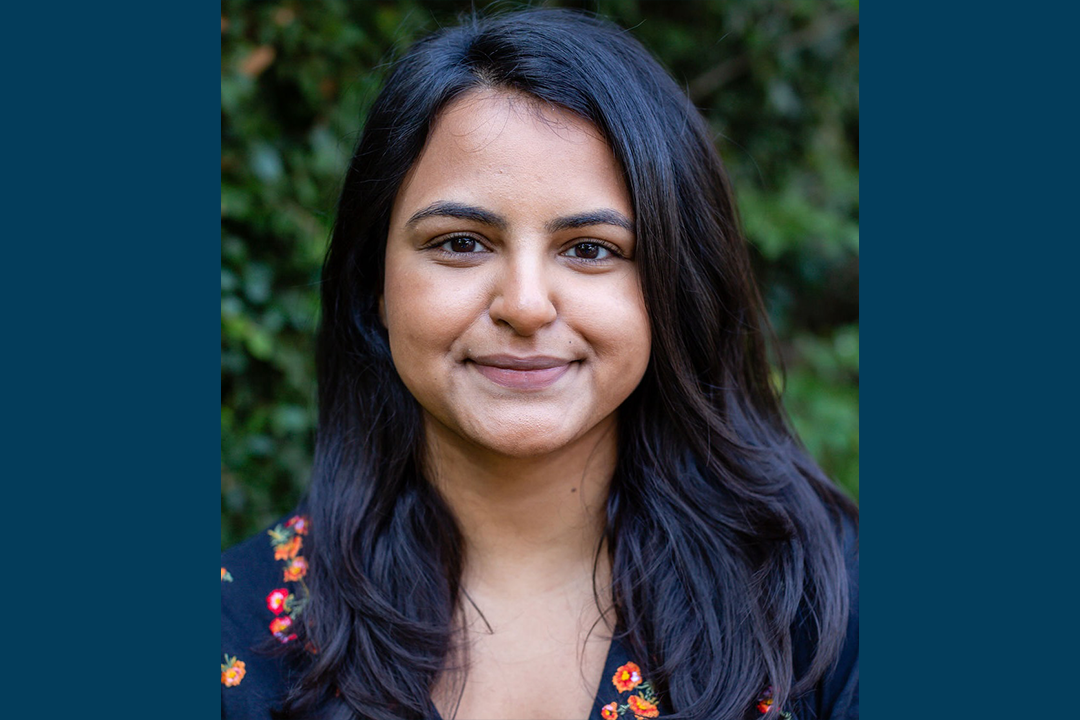
Ujwala Murthy, JD ‘27, first decided to go to law school after working for the East Bay Community Law Center in Berkeley, California, where she saw the impact lawyers can have on their clients and communities.
Motivated to be a part of that work, Ujwala chose to attend GW Law after hearing about the Public Interest and Public Service Law Center’s offerings. Over the past year and a half, she has taken advantage of every opportunity available to her.
Last summer, she interned at Pangea Legal Services, a San Francisco nonprofit specializing in deportation defense with the support of the Public Interest Grant Program. The San Francisco Chronicle quoted Ujwala about her work helping recently detained clients and their families navigate removal proceedings in that internship.
Ujwala built on those experiences in the Fall 2025 semester, when she did an externship through the GW Law Field Placement Program at the Federal Public Defender’s Office for the Eastern District of Virginia. And this summer, she’ll be interning with Brooklyn Defender Services in their New York Immigrant Family Unity Project unit.
Read the conversation below to learn more about Ujwala’s experiences at GW Law.
Why did you want to go to law school?
I was interested in advocacy and the policies that shape our lives, long before I made the conscious decision to go to law school. Before law school, I found ways to pursue that professionally. My very first nonprofit job was in San Francisco, at Room to Read, which is an international NGO focused on childhood literacy and girls’ education. Much of my job as a fundraiser involved advocating for the organization, especially in donor meetings. I look back on my time at Room to Read fondly because I met amazing colleagues all over the world who were organizing and building coalitions for social change in their communities.
I wanted to do the same where I lived, and so I joined the East Bay Community Law Center (EBCLC) in Berkeley, as a grant writer. It was really here that I understood two fundamental things: what it meant to be a lawyer, and that I wanted to be one. I’m the first in my family to pursue a J.D., and for a long time, I had a lot of misconceptions about the kind of person who becomes a lawyer. I thought I was not cut out for it, like I lacked some ‘it’ factor needed to be one.
But at EBCLC, I met thoughtful, conscientious, fierce advocates from diverse backgrounds, who all looked out for their clients and communities. I helped out a few times in housing court, to provide same-day support to tenants at risk of eviction. I knew it was time to apply for law school when I realized I wanted to do what the attorneys were doing, and writing about it no longer felt like it was enough. I was lucky to meet so many ‘role model attorneys’ that I look up to, whom I still reach out to for guidance.
Why did you choose GW Law?
When I was deciding on law school, I knew I wanted to be where the public interest students were. I first spoke with Professor Kate Weisburd, a brilliant advocate and scholar, who taught at GW Law. Coincidentally, she also worked at EBCLC, though we didn’t overlap. She said great things about her experience teaching at GW Law and its public interest offerings, and also connected me with another public interest student who I still go to for guidance. I remember, when I was still deciding, I spoke with an attorney who went to another law school, remarked on how unique GW Law’s public interest pre-orientation was. Looking back, this pre-orientation was where I met many talented, kind peers before school even started. And what Professor Weisburd said was true, too, because I’ve met professors working on incredibly nuanced, critical issues that affect us all, like surveillance, and I’ve befriended plenty of students committed to public interest work.
What interests you about public interest law?
At its core, the law impacts people in such a visceral way. And I think nowhere is that clearer than it is in public interest law. These are the types of advocacy and decisions that impact entire communities. It affects not only who our neighbors are, but how they are treated. It affects whether people eat. It determines who lives and who dies.
My first foray into the criminal legal system was in college, when I wrote the Wikipedia page for the late Kalief Browder, as part of a project for a class called ‘Black Lives and Deaths.’ Kalief Browder was a Black teenage boy arrested at 16 on suspicion of stealing a backpack in the Bronx, about two subway stops from my high school. He languished on Rikers Island for about three years waiting for a trial that never came, including almost two years in solitary confinement. Mr. Browder later ended his own life after being released. Writing about his life and the trauma done to him at Rikers fundamentally changed me and how I view justice, and lack thereof. Knowing that I was 14 years old when he was arrested, not too far from where he was arrested, I understood how arbitrary, yet also racially deliberate mass incarceration is.
Mr. Browder’s story isn’t necessarily unique. Nearly all the youth defense clients at EBCLC were youth of color. My time at EBCLC was really instructive in showing me how interconnected everything is to your ability to just exist, let alone thrive, like your income, your contact with law enforcement and the criminal legal system, your housing situation, your immigration status, access to government benefits like Medicaid or SNAP, and so on. Clients at EBCLC receive legal services from multiple programs, so a client could be referred internally from the Immigration Unit to the Housing Unit if they are seeking help with their immigration status but it’s discovered that they might be getting evicted. The staff there not only provided direct legal services but also advocated for policy change at the state and local level. So going into law school, I understood the importance of holistic legal services, but also using different channels to create change.
So when I decided to go to law school, I knew I wanted to confront the most pressing, salient issues of our time. Having worked at nonprofits for several years, I didn’t foresee myself stepping back, but rather going deeper. I didn’t come in laser-focused on any particular issue area, but broadly speaking, I entered law school interested in public defense, youth justice, immigration, housing, and civil rights.
How did you go about finding your summer internship at Pangea Legal Services? What were you looking for in a summer position?
I had heard great things about Pangea when I was working at EBCLC, from the immigration attorneys I worked with at EBCLC. Pangea is a nonprofit in San Francisco that specializes in deportation defense. When I saw that Pangea was hiring through GW Law’s Public Sector Recruiting Program (PSRP), I applied. I remember connecting well with my interviewer, who ended up being my manager that summer. She’s been a great advisor and mentor since! One piece of unsolicited advice is to seek supportive, good supervisors; they can really create such a formative, positive experience for you. Part of that is going where you feel comfortable and welcome, and sometimes, you can sense that in the interview process itself.
Like I mentioned, I didn’t come into law school knowing I would definitively work in immigrant defense, but I kept an open mind. When I was deciding on where to work over the summer, I realized I wanted to work in direct services and improve my client interviewing skills. These were skills I had only started developing a bit towards the end of my time at EBCLC, when I volunteered in housing court, so I knew I wanted to work more on that. Pangea also felt like a great opportunity to come back to California and support the immigrant community members who were my neighbors all those years I lived in San Francisco.
What was it like working at Pangea and working in deportation defense last summer?
It was a privilege to support clients and their loved ones during one of their most traumatic life experiences. The staff at Pangea made us interns feel super welcome as thought partners and contributors to the organization. As an intern, I supported clients in removal proceedings in both detained and non-detained settings. Through Pangea’s role in the Rapid Response Network across San Francisco, San Mateo, and Santa Clara counties, I worked with clients who were recently arrested by Immigration and Customs Enforcement (ICE) at their immigration court hearings, their homes, or at their routine ICE check-ins. It was a pretty unprecedented summer to be an intern in deportation defense, because things were changing rapidly, but the staff were always patient and answered our questions.
I performed intake interviews with recently detained clients and served as the point-of-contact to update their loved ones on where clients were being transported. This was happening really quickly, so overnight, a client could be moved to Texas or Louisiana, and it would be hard to get in touch and even harder for family to visit. At Pangea, I got to see how organizers, paralegals, and attorneys can work together like an orchestra. Each role is as important as the next, and all were responding synchronously with power over fear, no matter what. And I’ve come to realize that that’s all we have: unwavering people power. It was what kept me grounded during the emotional, demoralizing moments.
It also made me think about the importance of taking action, even in difficult times, and my own identity. As the daughter of immigrants, I’m always reminded that my own presence in this country was only made possible by generations of activists and lawyers who came before me.
How did it feel to see your work making an impact in people’s lives and seeing that reflected in the San Francisco Chronicle?
One of the attorneys I worked with described what we were doing as a helping hand reaching out in the darkness, and I couldn’t phrase it any better than that. Towards the end of my internship, I interviewed a client brutally arrested outside of his immigration court hearing. I got to support his habeas petition, which was filed in federal district court, in the Northern District of California. Thankfully, a federal judge granted a temporary restraining order (TRO) in this case, and he was released from detention soon after being transported to a detention center in Arizona.
The San Francisco Chronicle reached out about this story, which came out on the front page of the August 10th print edition. The article was called “‘It was hell’: Man recounts 4-day detention in S.F. ICE cell with zero beds and 6 other detainees.” I was glad to see it get the attention needed, because I saw some very egregious things happening in that ICE building in San Francisco. Before being transported to Arizona, the client was held in this San Francisco ICE building for several days without adequate food or medical attention, and the conditions were inhumane. There’s a dangerous precedent in that building of detaining folks. In the 1940s, a Chinese woman named Leong Bick Ha ended her own life there, after being detained in that building for three months, so it’s absolutely critical that we learn from history.
I was nervous because it was my first time being interviewed by a journalist. But the advocates I worked with taught me that it was important to bear witness, and our clients taught me that it was important to speak up about what I saw. More than anything, I’m glad that this client was released from detention and was able to share his experience firsthand with the Chronicle.
How was your work at the Federal Public Defender’s Office last semester compared to the deportation defense work last summer?
Last semester was my first time working in public defense. I saw a lot of similarities between the criminal legal system and the immigration system, though they are distinct systems. Mainly, I noticed how both are rooted in a dehumanizing carceral system. I noticed how people incarcerated in either system communicated with their loved ones using a communication system from the same private company, GTL. Towards the end of my time at Pangea, we began to hear about ICE transporting detained immigrants from California to the Federal Detention Center in Hawai’i, which is a federal prison, not an immigration detention center.
At the Federal Public Defender’s Office, I worked on a few illegal reentry cases, which I knew very little about at first. I worked with zealous advocates not only in the courtroom, but in their legal writing. I’m continuing to explore this intersection of the criminal legal system and immigration next summer, actually. I will be returning home to New York City to intern with Brooklyn Defender Services, in their New York Immigrant Family Unity Project (NYIFUP) unit. NYIFUP is one of the first of its kind, and basically functions as a sort of public defender model for detained immigrants, so that detained immigrants in New York have some semblance of universal representation. This is really important because you are not provided a government-appointed attorney, like a public defender, in immigration proceedings the way you are in criminal proceedings. I’m looking forward to better understanding how a client’s immigration status can affect them in criminal court and how a criminal record affects clients in seeking immigration relief.
What advice do you have for other GW Law students or potential law students?
Don’t be afraid to create something that you wish existed. A critical aspect of EBCLC was that it was started by law students after Reagan-era funding cuts obliterated a lot of legal aid. That sort of initiative and spirit felt palpable at my job there, and I definitely carried that with me. For example, when I got to law school, I met a few other students who were interested in forming a youth justice clinic at GW Law, which did not exist at that time. We met with Dean Laurie Kohn and put forth our proposal and a signed petition, after consulting with youth defenders in DC and understanding the youth defense landscape. The following academic year, the Youth Justice Division Clinic started under the Access to Justice Clinic umbrella at GW Law! Whether it’s a clinic, student organization, or pro bono project, there are probably other students interested, and you can try to get things up and running.
Relatedly, reach out to people, whether it’s another law student working in areas of law you are interested in, a practicing attorney at your dream job, or a professor whose expertise you are interested in, even vaguely so. It might even help you get an internship. The worst thing someone can say is no, and even then, it might be because they’re busy and they might be free to meet later. I’ve reached out so many times, and people have always been so generous with their time and guidance. Once, I reached out to a GW Law grad on LinkedIn to learn about where she works, and we had a great initial call. Now, whenever I’m in her city or she’s back in DC, we get coffee and catch up. It’s nice because I learn a lot from her and her experience, but I’m also able to share what I’ve learned from the niche areas I’ve worked in so far.